Back from the Deep South
The Michigan Vintner was invited to teach a session on Michigan Cab Franc and Riesling at the American Wine Society convention in Jacksonville Florida. While in the south, we also hit a few wineries and of course, we did a little golfing in Myrtle Beach.
As we travel outside of Michigan, very few people we encounter have any idea that Michigan makes excellent wine. For that matter, hardly anyone outside of Michigan knows anything about the state other than the auto industry and the Great Lakes. Not many can imagine a lake that you cannot see across or even see either side from the center. We hosted a Michigan Wine Collaborative table at a large walk around tasting attended by all 350 convention attendees. People loved the Michigan wines and were very curious about things Michigan in general.
Other than tart cherries, not too many people realize that Michigan’s agricultural diversity is second only to California’s. Michigan is #1 in the country in tart cherries, asparagus, black beans, navy beans, several red bean varieties, cucumbers and squash. Michigan is in the top ten in just about every other fruit or vegetable crop except for corn and soybeans. Ironically, corn and soybeans is our largest volume crop yet we fall way behind those sorts of field crops to the western states. So with such an incredible agricultural diversity, why are our fine wines such a secret?
My theory is that you have to be known for something to be known for anything. Thirty years ago, it seemed like Michigan was poised to be the number three wine producer in the country behind California and Washington leaping ahead of New York and Oregon. Today, we have fewer wineries than New York or Oregon and our reputation beyond our borders is pretty non-existent. What happened? Oregon became known for Pinot Noir and New York became known for Riesling. Of course, Oregon and New York, like Michigan have very diverse agricultural opportunities and as such grow and make fine wine from a long list of grape varieties. But, both states are known for SOMETHING. Michigan is not. So, the topic of my session at the AWS Conference was “Does Michigan Need a State Grape Variety”? Although many wineries are not convinced that advertising a specific grape variety or grape varieties in the wine industry promotional materials is a good idea, I ask, “what is the risk”? I believe the benefit is a coat tail effect. Because Oregon is known for Pinot Noir, people assume that fine wine is made there and Oregon Chardonnay, Oregon Syrah, Oregon Riesling all enjoy the quality reputation passed down from the Pinot Noir. Likewise this is true in New York where a plethora of cool climate varieties ride the coat tails of Riesling.
Back in the late 60’s and early 70’s Riesling came to SW Michigan by way of Tabor Hill and Lemon Creek. A few years later, Ed O’Keefe, founder of Chateau Grand Traverse planted his vineyard exclusively in vinifera grape varieties with Riesling as the flagship variety. As they say, the rest is history. Today over 700 acres of Riesling are planted from the Indiana border to the Straits of Mackinaw. Another variety with about 200 acres planted throughout the shores of Lake Michigan is Cabernet Franc. To me, it is not possible to be viewed as a serious fine wine producing state without being known for red wine of excellent quality. There is enough Cabernet Franc harvested every year that any winery wishing to produce a Cabernet Franc can buy grapes. The crop is out there for sale every vintage. Most importantly, no other state is known for Cabernet Franc. Even California and Washington have no reputation for Cabernet Franc because most of what they grow goes into Bordeaux-style blends and almost nothing is bottled as a varietal. The icing on the cake is that our Cabernet Franc is world class quality which would bring along all of the other wonderful Michigan red wines on its coat tails.
After explaining Michigan’s grape history, agricultural diversity, the impact of Lake Michigan and the killing frosts that prevent Pierce’s Disease and reduces the pressure of molds, rots and mildews we discussed the various Michigan AVA’s and acreage under grapes at my session. People were surprised to realize that our grapes are planted between the 42nd and 46th parallels with incredibly long summer daylight hours. We followed up with a brief tasting of Riesling and Cabernet Franc.
2025 EMMA REICHART Nahe Dry Riesling Qba (11.5% abv) GERMANY Like all of the European wines offered by Trader Joe’s, this wine is a picture perfect illustration of what German Riesling is expected to taste like. Though perhaps too young and fresh to illustrate the typical German “diesel” essence, this wine in every way showed why Germany is the world standard for Riesling. With something like 17 hours of daylight in mid-summer, it is no surprise that it embodies many of the nuances we think of as Michigan style. Yet, it did not receive any first place votes.
2022 O’BRIEN VINEYARDS Old Mission Peninsula Dry Riesling (11.4% abv) MICHIGAN The extended daylight at this site really exhibits the big ripe floral citrus-like brilliantly fresh fruit power embodied here. It was well received especially at our walk around tasting where we received loads of positive comments.
2023 LEMON CREEK Lake Michigan Shore (Dry) Riesling (13% abv) MICHIGAN Here we have what I refer to as the quintessential flavor of Michigan. The steely Riesling backbone is softened and lengthened with ripe apple-like fruit and subtle green herb nuance. For a dry wine, it is remarkably supple and generous in texture. It received many first place votes.
2025 CHATEAU CHANTAL Old Mission Peninsula Semi-Dry Riesling (12.5% abv) MICHIGAN I wasn’t sure how a Semi-Dry/Demi Sec style would go over with a pretty sophisticated audience. In the industry, we often joke that this style is the “bus load” style. However, this is a beautifully crafted fine wine! It is remarkably elegant, lively, loaded with white tree fruit essence and literally sizzles with fresh acidity on the finish. This was the favorite and received the most first place votes of any wine.
2023 VIGNOBLES LACHETTEAU Cabernet Franc Chinon Loire Valley (12.5% abv) FRANCE Like the Emma Reichart Riesling, this Chinon precisely defines what the world has come to know as classic Cab Franc style. I was quite surprised at the richness, deep color, body and texture in the finish. This is a pretty big wine exhibiting the terroir admirably yet, like the German Riesling, it received no first place votes.
2024 CHATEAU CHANTAL Proprietor’s Reserve Cabernet Franc Old Mission Peninsula, Krupka Vineyard (14% abv) MICHIGAN Though not a big blockbuster, the depth, complexity and layers of nuance really stand out on the heels of the Chinon. It is easy to see why the tasters were so swayed by the Michigan wines in this exercise.
2021 AURORA CELLARS Cabernet Franc Leelanau Peninsula (13.3% abv) MICHIGAN Though very nicely balanced with nothing out of place, the underlying structure, tannin and rich mouth feel suggest a sleeping giant. The exotic, spicy fruit will emerge more emphatically with time.
2022 LEMON CREEK Cabernet Franc Lake Michigan Shore (14.8% abv) MICHIGAN Like the Lemon Creek Riesling, the most emphatic thing one can say about the Cabernet Franc is that it possesses everything good about Michigan Cabernet Franc. There is a warmth suggesting ripeness while up front liqueur-like fruit extract shows zesty freshness. Hints of herb and earth complete a multilayered experience.
Interestingly enough, all three Michigan Cabernet Francs received the same number of first place votes. The wines were distinctly different, yet, universally liked by all of the attendees. There is no question in my mind that if Michigan based its reputation on Riesling and Cabernet Franc the whole country would logically want to explore Michigan wine and discover the Chardonnays, Pinot Grigios, Blaufrankisch, Grüners, Pinot Noirs, Auxerois’ and many many other varietals. We attended the Traverse City Wine and Food festival this summer and tasted at least 30 wines. I can say confidently that every single wine that I tasted would have scored a 16+/20 or higher. In fact, I’d say at least half of the wines, red and white, would have scored 18/20 (gold medal) on the American Wine Society scale. If you haven’t seriously examined Michigan wine in the past 10-15 years, you need to do so!
Special thanks to Lemon Creek Winery, Chateau Chantal, O’Brien Vineyards and Aurora Cellars for donating these wines for us to present to the American Wine Society. Also, a very special thanks to Emily Dockery Executive Director of the Michigan Wine Collaborative to solicit and coordinate the sourcing of these wines.
More adventures in Florida and South Carolina
Before we left Michigan, I contacted many wineries in Florida and South Carolina asking if any of them made dry wines from locally grown grapes. Unfortunately, I must not have made it clear that it was not an either/or question. Many wineries made dry wine from California grapes and many made sweet wines from locally grown grapes. At San Sebastian, we were even told that it is IMPOSSIBLE to make dry wine from locally grown grapes! With that in mind, we ploughed on and tasted a lot of Muscadine wines of all stripes. Here are a few of the places we visited and what we found.
St. Augustine
Our first stop was San Sebastian Winery. The wine tasting is a very nominal price of $5 but, you do not get to choose the wines. I really wanted to try their Cream Sherry which I hypothesized that if St. Julian can make world class Cream Sherry from Niagara maybe it would be possible to do this with Muscadine if that is what they were doing. Most of their wines are either California wines made from either juice, concentrate and/or grapes or sweet Muscadine. The California Pinot Noir was very well made and characteristic of its type. The wine that interested me most was the Vintners Red made from the Noble Red Muscadine. Apparently, the Muscadine species has dozens of sub-varietal versions and clones. This one had fine balance and clean fruit that encouraged another sip. We were told that the juice of the Noble Muscadine is also red which explains the very deep color which other Muscadine’s do not possess. Though very sweet, it is balanced off by the tannic texture and clean acidity.
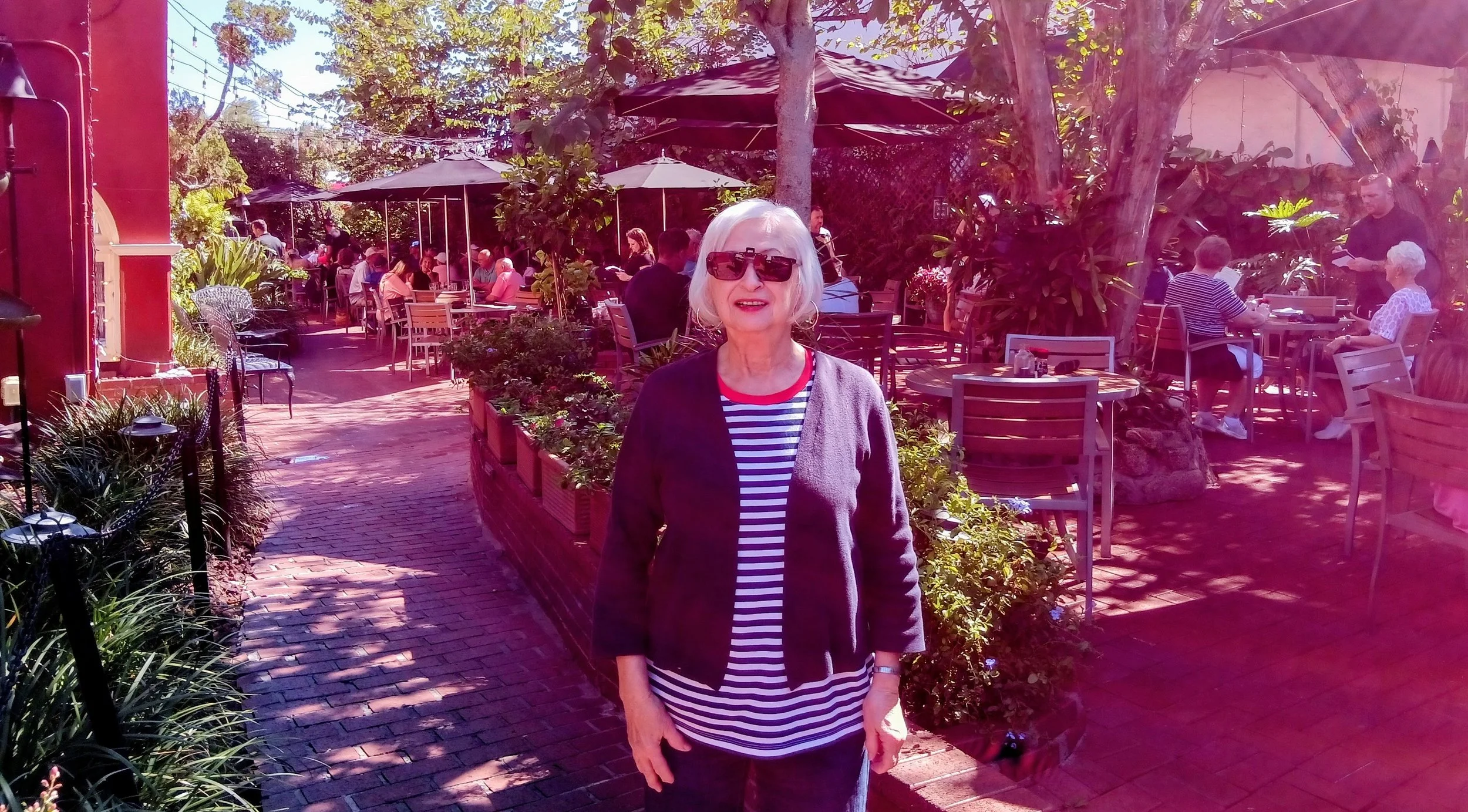
We had lunch at Harry’s Seafood Grill and Bar (pictured above). This was the culinary highlight of our trip south. Here, it is all about home style cooking with the precision of Jacques Pépin. We had grouper, shrimp, collards and red beans ‘n rice with a banana crème brûlée for dessert. Everything was prepared just perfectly showing off seafood with just a hint of crust, moist tender meat and a flavor that reminds one of the salty sea smell of the ocean. I learned a new word. When I picked up the collards bowl and drank the liquid in the bottom of the bowl, the ladies at the next table advised me in the south they call that a “potlicker”. It was so good; why not?
After the convention, we headed up to Myrtle Beach SC for a little golf and winery hopping. The golf was good. At Myrtlewood, the greens were in perfect condition but mysteriously slow considering the very manicured appearance. The fairways were soft with fluffy lies and we got a surprising amount of roll considering the lush damp grass throughout. But, if you’re legs are wobbly this is not the course to play. We were completely exhausted after 13 holes for a few reasons. Even though the overall terrain is dead flat, the course is very sculpted with deep undulating swales, ridges and major elevation changes especially around the greens. Making it all the worse, the golf carts cannot be driven within about 75 yards of the green. So, just about every hole involves a long uphill trudge to putt out. Indigo Creek was much less sculpted and you could drive a bit closer to the greens. The fairways were lush, green and well manicured but the greens were cut so short as to be pretty burned out. But, I’ll have to admit that they putted very true and fast in spite of the appearance.
We stopped in at La Belle Amie Vineyard which had some sort of concert going on that made it very confusing if you wanted to enter the tasting room and taste a flight of wine. As it turns out, there was no dry wine made from local grapes here but Michelle who manages the tasting room did introduce us to Twisted Sisters Sweet Baby Blue which isn’t actually all that sweet. It is a pretty balanced blueberry wine with enough texture to serve well as a table wine.
The best stop was at Duplin Winery in North Myrtle Beach. Here, I tasted quite an array of Muscadine based wines ranging from dry to semi-dry. All were well made. The best of them was the Burgundy that at 1.5% RS was hardly bone dry but the Muscadine fruit was in full bloom with grip, a cleansing mid palate acidity and a nice “pop” of ripe spicy fruit to finish it off. Another wine that I would describe as South Carolina’s stab at a Norton type of wine was called Founders Noble. It was pretty over the top but if I were a younger man, I’d consider putting away a bottle or two for twenty years to see what happens.
The industry is in its infancy. I’m glad to see the embrace of Native varietals such as Muscadine which are naturally resistant to Pierce’s Disease, molds, rots and mildews and require almost no chemical interventions in the vineyard. I probably won’t see it in my lifetime, but I do predict that at some point, the southern wineries will make wines from Muscadine that rival Missouri Norton and Cynthiana.
Enjoy in Good Health,
A Brian Cain, the Michigan Vintner


