EVEN MORE Great Wines for 2026
We had planned on opening a great Champagne New Year’s Eve to conclude my blog post for 2025 but, we got tired after the OSU vs Miami game and went to bed. So we had Mimosas after breakfast and decided to start in earnest with “more great wines” for dinner.
TASTED 2/14/2026
Alice is not a fan of lamb shoulder chops. It is my favorite cut on the beast and when having one lightly grilled to medium rare seasoned with rosemary I am transmitted to Les Baux overlooking the Bauxite mines breathing the fresh country air. Our compromise was Irish lamb stew made with shoulder meat. To bring it back to Southern France, we enjoyed a bottle of 2019 Bertrand Stehelin Sablet “Cheval Long” Côtes du Rhone Villages FR (13% abv) marked $27 though I think I bought it on sale at the Village Corner for less. Sablet is another cliff-side town quite a bit north of Les Baux overlooking the Plain de Dieu. The nose is pure Southern France with red fruit, dried green herb and pepper. The palate is balanced, clean and reinforces the red fruit essence. It is a very enjoyable wine, but once again, I’m disappointed. They just don’t make Rhone reds like they used to. Maybe it is too old or maybe it just never had the energy, bright acidity, menthol-like cooling sensation on the palate or vitality I miss from the wines we imported at D&W and Erika’s Deli.
TASTED 2/11/2026
Once again, we enjoyed the eye of rib-eye and cap pinwheel (see 1/24/2006 below). I broke into my Long Shadows Vintners Collection from 2012 and grabbed a bottle of Allen Shoup / Gilles Nicault 2012 Chester / Kidder Columbia Valley Red Wine WA (14.9% abv) about $60 for a current vintage. The majority of the mostly Bordeaux heritage grapes were grown in the Walla Walla and nearby Candy Mountain AVA’s along with a dollop of Syrah from the Horse Heaven Hills. Unlike most mature wines I’ve opened, this one had zero sediment and zero chemise. The cork was unstained and looked brand new. The color is a dense black/red with no meniscus transparency. So, it is not surprising that it smells and tastes like a young wine. Alice described it as mature and balanced with just a bit of raw vitality. The accompanying literature describes the nose as fig, cocoa, tamarind and oak. It is certainly a smell that I’ve encountered but I would differ on my adjectives. I get another wood other than oak and a spice more like turmeric or saffron. Lots of cherry jam too. The palate starts out silky smooth, lush and sweet but quickly grips with tannin and citrus-like acidity. Had I tasted it blind, I might have guessed less than 5 years old. It is absolutely delicious and I do think it is ready to drink. It is one of the best Washington State wines that we’ve enjoyed in years. Sadly, because there is only one bottle of each winemaker’s effort in the Vintners Collection, we won’t have the luxury of tasting another bottle in ten years.
TASTED 2/7/2026
As the 2009 futures we purchased many years ago have dwindled, this is one of the few wines left in which we had more than one bottle. So, with tonight’s fondue I decanted a bottle of 2009 “Aster de Beaulieu” Château la Roche Beaulieu, Castillon Côtes de Bordeaux (80% Merlot / 20% Cab Fr) FRANCE (14.9% abv) today’s vintage in the $30 range. Nice to drink those kind of wines fully mature that we probably paid no more than $12 back when. This has been one of my favorite 2009’s and remains so. Like most of the wines reviewed below, the inside of the bottle is encased in a dark chemise* yet, it decanted brilliantly clear. It is really dense, rich, composty and full of very fresh black berry fruit. As soon as I pulled the cork, cassis and sweet berries emerged. On the palate, the best part is the finish. The middle is a nice rich balanced expression of what the nose eluded to but as one swallows, it builds texture magnifying fruit and toast. Though maybe not quite in the “Great Wines” category, it is so finely balanced and thoroughly enjoyable that I felt it worthy of this blog post.
*I’ve got a few feelers out among my winemaking friends to see if anyone knows why recently almost every mature wine I open has a chemise. Different winemaking practices? Different wine drinking habits on my part? A cellar that is not as cool or as consistent as those underground cellars I had previously? I’ll report any findings I come up with. ABC
TASTED 2/1/2026
After last nights disaster, Palazzo della Torre, over the hill and back-up Rubinelli Vajol Valpolicella Ripasso, corked, I had to come up with something which would suggest to Alice that I still know something about wine. So, my go-to “Bordeaux in summer (or winter)” prevailed. 1999 Chateau Clerc Milon (Baronne Philippine Rothschild) Grand Cru Classé Pauillac, Bordeaux FR (12.5% abv) for the current vintage about $125 was just exactly what I needed to get out of the doghouse. Alice loved it with a “thank God, not another spoiled wine” smile of well-being as she savored her first sip. Yes, after last night’s wine, it was heaven. Like Napa Cab, Left Bank Bordeaux does possess that very distinct aroma that as soon as the cork is pulled and decanting progresses, anticipation is paramount. A whiff later with the wine in the glass, it proved classic Pauillac of fine breeding and nobility. Yes, it is undeniable and it is in the terroir. I often wonder if my home winemaking career had taken place in the shadow of a Grand Cru vineyard, would I have made wine like this? The wine is fully mature (our last bottle) and its strength is its complexity and loyalty to its location. Cedar, of course, with some compost, highly volatile red fruit, marmalade, roasted carrot and wet wood give a glimpse to what is coming. The palate reinforces the bouquet finishing clear, clean, and remarkably soft. Very nice wine. If I were rating it, I’d give it a GOLD for it’s representation of Pauillac, but as far as winemaking, I couldn’t go higher than silver. Perhaps, our encounter with several great California wines lately left me wanting just a bit more substance from a wine asking more than $100 for the price of admission.
TASTED 1/24/2026
If you like the prime rib-eye cap pinwheels, they are super easy to make. However, you need to have a spouse who prefers leaner meat because the pinwheel is just the cap portion of the rib-eye leaving the eye of rib-eye out. When buying rib-eyes look for ones with about 50/50 proportion of eye and cap. Cut the cap away from the eye very carefully in one continuous strip. You can remove the large clods of fat, but a nice blend of fat and meat is fine. Roll up the cap like a pinwheel and tie it with a string. Because it is tied, it will be about a 1/4 inch thicker than the eye so if you cook them the same, the eye will be a half a degree more done. At least an hour before cooking, I use a few good shakes of Worcestershire sauce with cracked pepper and steak seasoning to season the meat and let it come up a bit closer to room temp. In a hot frying pan, melt about three tablespoons of butter. Put a few springs of thyme in the hot butter and lay in the steaks. At about 4-5 minutes, flip them and put a couple of smashed cloves of garlic in the butter. When the garlic is nicely browned place it on top of the steaks. After the steaks have cooked about 4-5 minutes on the other side place them on warmed plates and pour the pan butter over them. If the pinwheel is rare, the eye will be about medium rare. Try this and you’ll never use a barbeque grill again. Alice likes Malbec so I grabbed a bottle of 2007 Cheval des Andes Mendoza Red Blend (Malbec, Cab and other Bordeaux Heritage grapes) ARGENTINA (14% abv) well over $100 these days. It is another chemise-crusted bottle that decanted brilliantly clear with deep ruby surrounded by a somewhat rosy edge I hate to use overworked wine critic words but the nose is pure cedar. Both the smell of the cedar wood and also a hint of the gin-like greens. Yes, it is emphatically all the classic smells critics use to describe Bordeaux blends; dusty terra cotta and massive concentrated red fruit. Whether Cab, Merlot or in this case, Malbec, it just spills over with all the smells and flavors we use to describe the worlds best claret style wines. The texture is completely flavor driven. It is one thing to have gripping soft tannins but, it is quite another to have tannin loaded with cedar, Mediterranean herbs, char, and strawberry jam. It is so compelling you can’t look away.
TASTED 01/18/2026
Alice is really becoming a California Cab girl. She pretty much has eschewed the bright, edgy, lively wines I call desert island wines in favor of big round well oaked Cabs and Merlots. So, with tonight’s fondue I brought out a bottle of 2016 Amavi Cellars Estate Walla Walla Cabernet Sauvignon WA (14.5% abv) about $40 for the current vintage. This is the last bottle of our Last Bottle selections of Amavi from way back when Last Bottle mostly sold top quality overpriced wines reduced to the $10-20 range. There must be a real shortage of good Cabernet based wines these days because the price increases have way outpaced quality with West Coast Cabs. I don’t see today’s wines significantly better than those of a decade ago, yet prices have at least doubled and if the wine has any reputation, the prices have tripled. Anyway, this is actually a Meritage blend employing all five of the popular Bordeaux Heritage varietals dominated by 78% Cabernet Sauvignon. Classic varietal bouquet of riper than ripe black fruit meshed with earth, leather and oak seamlessly slides across the palate with Rioja-like terra cotta mouthfeel finishing long, rich and mouth watering. It is a beautiful wine caught precisely at its peak. After dinner watching the Bears and Rams Alice suggested another big Cab and I seem to have gotten it just right with a follow up. 2012 Hall Napa Valley Cabernet Sauvignon CA (14.9% abv) about $60 for the current vintage was indeed the perfect follow up. Though not quite as big as the Amavi, there is just something about Napa that stands out. I’d actually say that the Amavi is not only a bigger wine but also a better wine. But, the Hall has Napa magic and the Amavi from Walla Walla does not. There is just such a translucent quality to every element within the Hall that illuminates. Yes, it is classic Napa with cassis, herbs, olives, sweet oak, and a mid palate surrounded with leather and tobacco but the purity of red fruit at the end balanced by fresh acidity just makes it so compelling. Again, not a big wine, but every sip triggers a longing for another. Here’s a great fresh wine that I think is as good as it will ever get though I will attempt to age our remaining two bottles to see what other magic might emerge.
TASTED 01/14/2026
Tonight the subject of our ZOOM wine tasting group is Meritage. So, I went in the cellar to get a mature bottle of Meritage and realized that I did not have a single bottle older than 2023. Yes, I had many California red blends from Phelps Insignia to Lyeth Estate but nothing with the word “Meritage” on the label. Turns out that the once top blended wine made from Bordeaux Heritage grapes had gotten so diluted by cheap imposters that the top Meritage producers simply came up with names of their own with no mention of Meritage. By the way, Meritage rhymes with heritage. The word is a contraction of Merit and Heritage. It is a made up American word and has nothing to do with French Hermitage. So for tonight’s exercise, I brought out a 2007 Ridge Santa Cruz Mountains Estate Red Wine (58% Cabernet Sauvignon and 42% Merlot) grown on the legendary Monte Bello vineyard CA(13.3% abv) originally purchased for about $40, today closer to $100. This particular wine is no longer made. Now, from the Monte Bello vineyard only two wines are made. The Monte Bello Estate which is a Cab/Merlot blend and a Cabernet Sauvignon. This particular bottling is from that same Monte Bello vineyard but at the time believed to be more forward and more likely to mature sooner than traditional Monte Bello Estate wines. I believe they are correct. We had a 2000 vintage Monte Bello about a year ago and it was hard and not particularly attractive. This wine at the tender age of 18 is fully mature. Like the Estancia below, the bottle was left with a chemise that completely coated the inside of the bottle after decanting. It poured brilliantly clear and as I was decanting it, the kitchen filled with the scent of black currant and vinaceous expectations of greatness. The perfume is remarkable! The palate is full of complex, fresh fruit sensations, even a bit of citrus peel with composty, leathery, earthy, gumption and a soft but firmly tannic finish. This is absolutely at its peak. We’ll have to enjoy the other bottles soon.
TASTED 01/01/2026
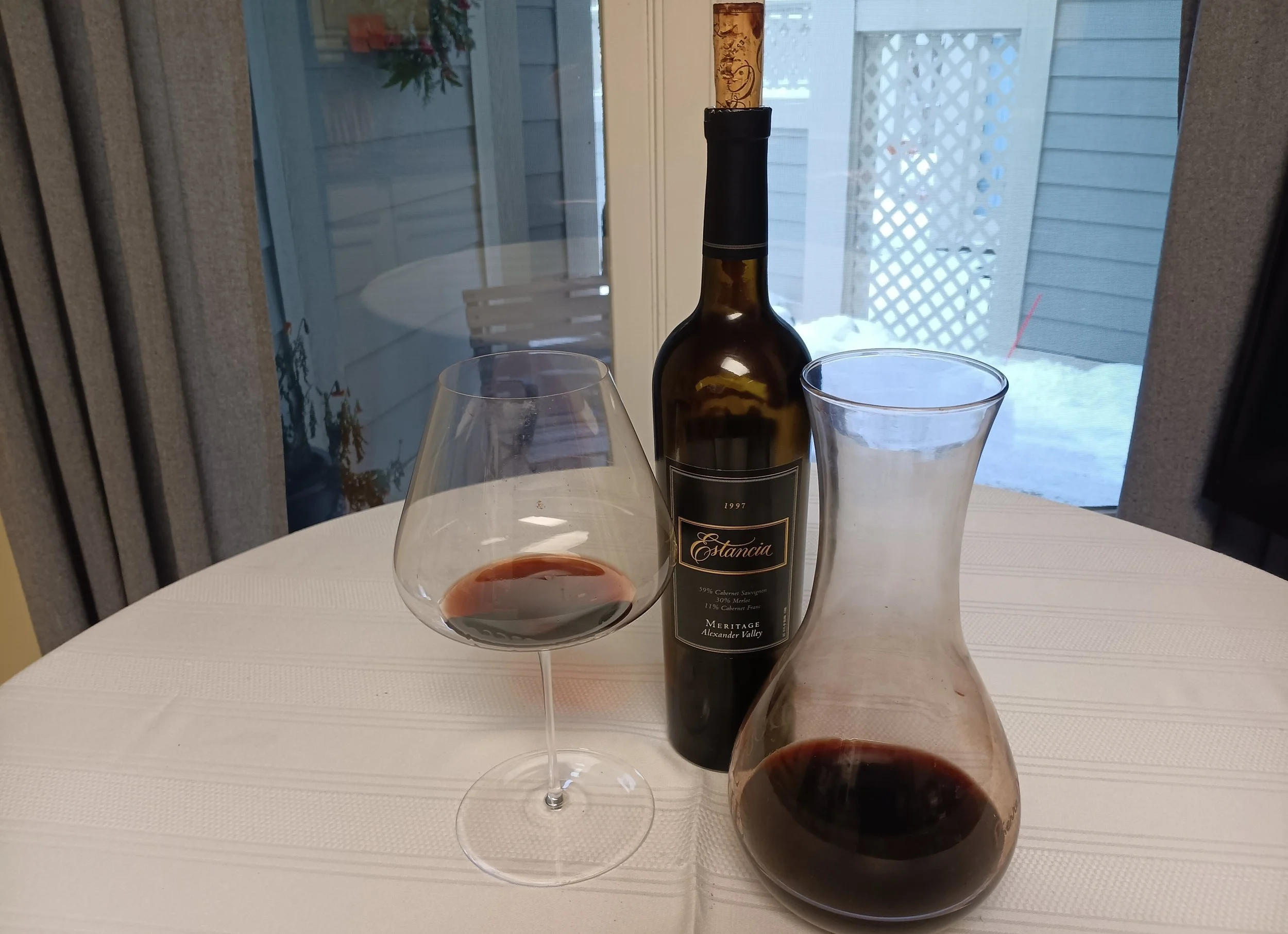
With our usual fondue tonight, I dug out a bottle that could have been included in the “Dead or Alive” post except that there was no doubt in my mind that it would not only be ALIVE but, really show well. I had no idea that it would show this well, however. 1997 Estancia (Simi) Alexander Valley Meritage (59% Cab Sauv/30% Merlot/11% Cab Fr) Sonoma County CA (13.5% abv) originally about $20, no longer available. Although the Estancia Winery now in Soledad (Montery County) also the home of Franciscan still exists, it is no longer the same winery, vineyard or location of this wine. 30+years ago, Simi had an abundance of top level grapes from a vineyard known for its highly complex volcanic soil owned by Simi for what back then was Simi Reserve. It was dubbed Estancia. Back then, Estancia was a source of disposition for excess wine from Franciscan Estates too. When the Estancia brand became an actual winery located in Monterey making a red Meritage from grapes grown in Paso Robles, the Estancia brand name was dropped from Simi’s portfolio. Those grapes from the famous volcanic cap that flew over the county from Mt. St. Helena during an ancient explosion became branded as the Simi Landslide Vineyard. But, I haven’t seen the Landslide Vineyard on the market in at least five years, so that may have disappeared too. No, don’t worry, the vineyard still exists and the grapes have certainly found a new home with a very willing buyer. If anyone reading this knows where those grapes from the volcanic vineyard have ended up, please contact me. Aside from the history, the wine is and has always been one of the most remarkable wines from Northern California. Though I am a bit partial, in general, to Napa Valley, this Sonoma County Alexander Valley wine is as good as any wine from anywhere. The cork had the look and feel of a newbie. It popped right out with an AH-SO. The nose immediately made itself present while I decanted the wine which had a large chemise coating just about the entire bottle. That is always a sign of a great vintage to have so much excessive pigment. The color of the wine was very deep red with burnt Sienna tones well beyond the meniscus. Vineyards with complex rocky soil types just have that something that is hard to put into words but the second you stick your nose in the glass you recognize the spice, compost, highly concentrated condensed jammy fruit and oak that you can’t really smell or taste but makes is presence quite apparent. While we were drinking it with dinner, I never even took note of the rich palate cleansing tannin. But, it is there giving this silky smooth wine some real mouth-feel. This is our last bottle of Estancia made from this vineyard but still do have one bottle left of Simi Landslide. It is a 2007 presumably with lots of life, so my only concern now is to be sure to drink it while we have any life in us. Happy New Year!!
Enjoy in Good Health!
A Brian Cain, the Michigan Vintner